


Table of Contents
- Why Most Lifting Tees Fall Apart (And How to Spot Durability Before You Buy)
- Performance T-Shirt Fabric: What Actually Holds Up Under a Barbell
- Seams, Stitching, and Abrasion Points That Decide How Long a Tee Lasts
- Gym Shirt Fit for Lifting: Why Cut and Stretch Matter More Than Size
- Best T-Shirts for Weightlifting: What to Look For in a Real Lifting Tee
- How to Wash Workout Shirts So They Keep Their Shape and Color
- Durability Tests You Can Run Before and After You Buy
- Conclusion: Build Your Gym Wardrobe Around Gear That Outlasts Excuses
- Frequently Asked Questions
Last Updated: October 14, 2026
Why Most Lifting Tees Fall Apart (And How to Spot Durability Before You Buy)
Most lifting tees fall apart because they were never built for the bar. They were built for a photo shoot. Thin cotton, single-stitched hems, and loose collars survive a mirror check but not a deadlift session.
At Iron Gods, we've watched too many lifters buy the same cheap shirt three times instead of one good one.
Here's the hard truth: a shirt fails at the seams and the fabric before it ever fails at the logo. Below, we'll show you exactly where to look.
Performance T-Shirt Fabric: What Actually Holds Up Under a Barbell
Performance t-shirt fabric holds up when it balances strength, stretch, and moisture handling. The right blend resists abrasion, keeps its shape after dozens of washes, and does not turn into a petri dish for odor-causing bacteria.
Four fiber types do most of the work in gym clothes:
- Cotton breathes well and feels soft, but it soaks up sweat, dries slowly, and loses shape under repeated tension.
- Polyester wicks sweat, dries fast, and resists stretching out, but low-quality versions can pill and hold onto odors.
- Spandex adds stretch and helps the shirt snap back into shape, though it degrades with heat over time.
- Nylon adds strength and abrasion resistance without much weight, making it useful in high-friction areas.
Pure cotton feels great on day one. It sags by month three. That's the trade-off most guides skip.
Cotton, Polyester, Spandex, and Blends: The Durability Trade-Offs
Blends beat single-fiber shirts for lifting. A cotton-poly mix keeps some softness while adding strength. A poly-spandex mix gives you stretch and fast drying.
Here is how the common options compare for lifting-specific durability:
- 100% cotton: High comfort, low abrasion resistance. It absorbs sweat and stays wet, which accelerates fiber breakdown and odor. It also shrinks and stretches unevenly after repeated washing.
- Cotton-poly blends (50/50 or 60/40): A middle ground. The cotton adds softness; the polyester adds strength and faster drying. These blends resist pilling better than pure cotton but may still hold odor if the polyester is low quality.
- Poly-spandex blends (typically 85-90% poly, 10-15% spandex): The best balance for lifting. Polyester handles sweat and abrasion; spandex provides stretch and recovery. These blends keep their shape after repeated laundering and dry quickly.
- Nylon blends: Nylon adds exceptional abrasion resistance, which helps against barbell knurling and bench edges. It is often blended with spandex for stretch. Nylon dries quickly but can feel slicker than cotton.
Fabric weight matters too. Heavier knits (measured in grams per square meter, or GSM) resist thinning at the shoulders and chest.
Abrasion resistance is the key differentiator for lifting. Barbell knurling, J-hooks, and bench pads grind against the fabric.
Odor retention is another factor. Polyester is notorious for holding onto oils and bacteria if not washed properly.
The Textile Exchange materials guide notes that fiber choice drives how a garment performs over its life.
Seams, Stitching, and Abrasion Points That Decide How Long a Tee Lasts
Seams and stitching decide how long a tee lasts, not the print on the chest. A shirt with strong seams outlives a prettier shirt with weak ones every time.
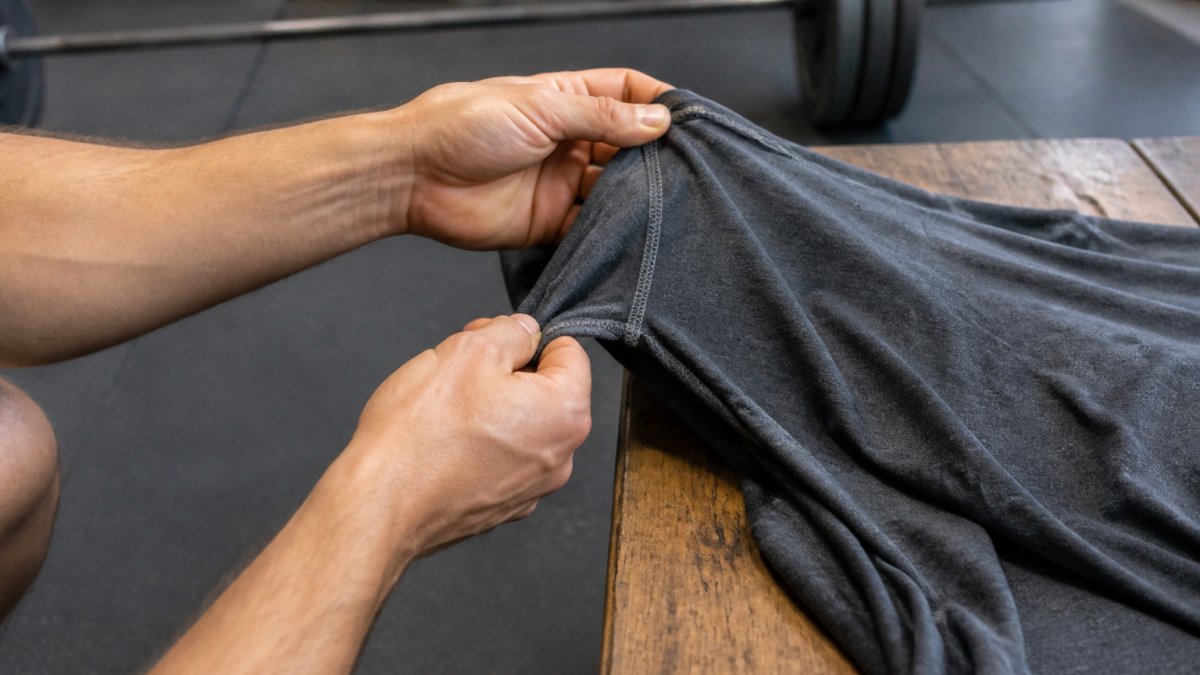
Check these points before you buy:
- Shoulder seams take the most stress during pressing and pulling.
- Side seams rub against plates and benches.
- Armhole stitching stretches every time you raise your arms.
- Hems fray first when the stitch is loose.
Bar abrasion is the silent killer. The knurling on a barbell grinds against your chest and shoulders on every rep. Flat-lock or double-stitched seams handle that friction far better than single stitching.
Gym Shirt Fit for Lifting: Why Cut and Stretch Matter More Than Size
Gym shirt fit for lifting comes down to cut and stretch, not the number on the tag. A shirt that binds at the shoulders limits your range of motion and tears at the seams.
Look for these fit traits:
- Room through the chest and shoulders
- A tapered waist so the fabric doesn't bunch
- Enough stretch to reach full lockout overhead
- A collar that keeps its shape after repeated pulls
Bigger lifters with wide shoulders and a smaller waist get the worst of it. Standard sizing rarely fits both. That's why cut matters more than the size label.
Our ASTM International standards for apparel sizing reference point shows how much fit varies across brands. Always check the size chart, not your usual number.
Best T-Shirts for Weightlifting: What to Look For in a Real Lifting Tee
The best t-shirts for weightlifting share a few traits: strong seams, a stretch blend, and a cut built for movement. Skip anything that only looks the part.
A real lifting tee has:
- A poly-spandex or cotton-poly blend
- Reinforced shoulder and side seams
- Moisture-wicking and quick-dry fabric
- A fitted cut that moves with you
This is where Iron Gods earns its place. Our Strife Workout T-Shirt uses a 60/40 poly-spandex blend that wicks sweat, dries fast, and fits like a second skin. The Assault Dri-Fit Workout T-Shirt and Engage Dri-Fit Workout T-Shirt use the same blend with anti-static fabric that holds up through heavy sessions. For a rugged cotton-poly option, the Logo Camo Workout Tank is built from a 50/50 blend ready for hard training.
Iron Gods Logo Camo Workout Tank →

| Feature | What to Look For | Why It Matters |
|---|---|---|
| Fabric blend | Poly-spandex or cotton-poly | Adds stretch and strength |
| Seams | Double or flat-lock stitched | Resists abrasion and splitting |
| Moisture handling | Wicking, quick-dry | Keeps you dry and light |
| Cut | Fitted, tapered waist | Allows full range of motion |
How to Wash Workout Shirts So They Keep Their Shape and Color
How to wash workout shirts the right way comes down to more than cold water and air drying.
Heat is the enemy of stretch and dye. Hot water and high dryer temperatures break down spandex fibers, fade colors, and cause cotton to shrink. But there are other factors that matter for lifting tees specifically.
Follow this routine to extend the life of your lifting tees:
- Turn the shirt inside out before washing. This protects the outer surface from abrasion against other garments and reduces pilling.
- Use cold water on a gentle cycle. Cold water preserves spandex elasticity and reduces dye loss. Gentle cycles minimize mechanical stress on seams.
- Skip fabric softener. Softeners coat wicking fibers and reduce their ability to move sweat away from your skin. They can also trap odors.
- Air dry or tumble on low heat only. High heat is the fastest way to kill stretch and shrink cotton blends. If you must use a dryer, use the lowest setting and remove the shirt while slightly damp.
- Wash separately from rough items. Jeans, towels, and items with zippers or Velcro abrade the fabric and accelerate wear.
- Wash soon after training. Letting sweat sit overnight allows bacteria to multiply and odor to set into the fibers. The longer sweat stays, the harder it is to remove.
Sweat odor builds when bacteria settle into fibers. Polyester is especially prone to holding odor because its fibers are oleophilic, they attract oils and bacteria. Washing soon after training stops that.
How Repeated Washing Changes Fit and Sizing
One of the most overlooked durability issues is how a lifting tee fits after 20 or 30 washes. Cotton shrinks, spandex relaxes, and seams can pucker. A shirt that fit perfectly in the store may become too tight in the shoulders or too loose in the waist.
To account for this:
- Expect some shrinkage in cotton blends. A 100% cotton shirt can shrink 3-5% in length and width after the first few washes. Cotton-poly blends shrink less, typically 1-2%.
- Spandex loses recovery over time. If a shirt feels loose after a few months, the spandex is likely fatigued. This is accelerated by heat.
- Collar and hem shape can degrade. A collar that loses its shape after washing often indicates a weak neckband construction. Hems may fray if the stitching is loose.
When buying, consider sizing up slightly if the shirt is 100% cotton and you plan to machine dry. For poly-spandex blends, your normal size is usually fine because they resist shrinkage. Always check the care label and follow it, manufacturers design their fabrics to perform best under specific conditions.
American Cleaning Institute fabric care guidance
Durability Tests You Can Run Before and After You Buy
You can test durability before and after you buy with a few simple checks. These take seconds and save you from repeat purchases.
Before you buy:
- Stretch the shoulder seam and look for gaps.
- Pull gently on the hem to check the stitch.
- Hold the fabric to light to spot thin spots.
- Check the blend on the tag, not the marketing copy.
After you buy:
- Wash it once and check for shape loss.
- Look at the seams after a month of training.
- Watch for fading and pilling at friction points.
- Check if the collar still holds its shape.
A shirt that passes these checks will outlast three that fail them.
Conclusion: Build Your Gym Wardrobe Around Gear That Outlasts Excuses
Cheap gear quits before you do. Every split seam and faded shirt is money wasted and a reminder that shortcuts don't hold up under the bar. Build your wardrobe around pieces that last, and you spend less time replacing and more time training.
Iron Gods builds gym apparel for lifters who train hard and expect their gear to keep up. Our tees use stretch blends, moisture-wicking fabric, and cuts made for movement. You are stronger than your excuses, and your gear should prove it.
Get started with Iron Gods and train in apparel built to outlast every session.
American Cleaning Institute fabric care guidance
Frequently Asked Questions
What is the most durable fabric for lifting tees?
Blends hold up best. A 60/40 poly/spandex mix like the Iron Gods Strife or Engage tees resists stretching, dries fast, and keeps its shape through repeated wash cycles. Pure cotton feels soft but absorbs sweat, gets heavy, and wears faster at friction points. Look for performance fabric with some stretch and a tight knit so the shirt holds up under barbell contact.
Should a lifting shirt fit tight or loose?
Go fitted but not restrictive. A snug cut keeps fabric from snagging on bars and benches, which is where most tears start. You still need full range of motion for overhead presses and deep squats. Check that the shoulders and chest feel locked in without pulling, and that the hem stays put when you raise your arms. If it bunches under a belt or rides up mid-set, size down or try a different cut.
How should you wash workout shirts to make them last?
Turn them inside out, wash cold on a gentle cycle, and skip the dryer. Heat breaks down spandex and fades prints. Hang dry or lay flat. Use a small amount of detergent, avoid fabric softener because it coats performance fabric and traps odor, and never wash with rough items like towels or jeans that cause abrasion. This routine keeps dye, stretch, and stitching intact far longer.
How can you tell if a gym tee is well made before you buy it?
Check the seams first. Flatlock or reinforced stitching at the shoulders and side seams signals a shirt built for stress. Give the fabric a firm pull: it should snap back without staying stretched. Look for tight, even knitting with no thin spots. Read the care label and fabric content. A shirt with a clear blend ratio and specific performance claims is usually more reliable than a vague 100% cotton basic.
Sources referenced in this article are provided for general guidance. Always check current official information for the latest standards.


0 comments